








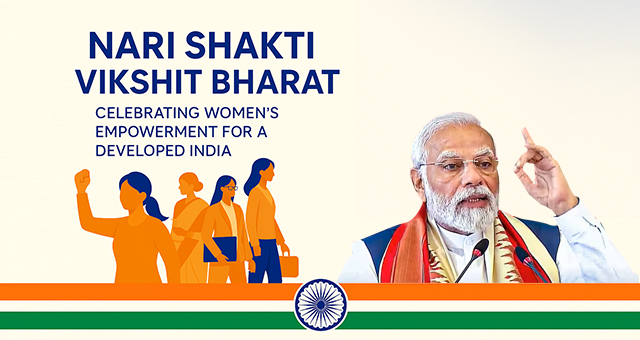
Nari Shakti is emerging as a transformative force in India’s march toward becoming a Viksit Bharat by 2047. With the government setting a bold target of achieving 70% women workforce participation, the empowerment of women has moved from the margins to the mainstream of India’s development strategy. Under the dynamic leadership of Prime Minister Narendra Modi, women are breaking traditional barriers and taking on leadership roles in business, governance, innovation, and community development. From grassroots entrepreneurs in rural India to CEOs in boardrooms, Nari Shakti is no longer just participating in the nation’s growth story—it is leading it. This marks a fundamental shift in India’s socio-economic fabric, where women are being recognized not just as beneficiaries but as architects of national progress.
The increasing representation of women in the workforce is a testament to the growing strength of Nari Shakti. According to the Periodic Labour Force Survey (PLFS), the Worker Population Ratio (WPR) for women rose from 22% in 2017-18 to 40.3% in 2023-24, while the female unemployment rate declined from 5.6% to 3.2% during the same period. The impact is particularly profound in rural areas, where female employment jumped by 96%, while urban areas witnessed a 43% rise. These numbers reflect a nationwide transformation powered by Nari Shakti, which is increasingly contributing to both the formal and informal sectors of the economy. As job opportunities expand and societal norms evolve, women are stepping forward with confidence and competence.
Skill development and education have been critical enablers of Nari Shakti’s ascent. Employability among female graduates has risen from 42% in 2013 to 47.53% in 2024. Likewise, women with postgraduate education or higher have seen their WPR rise from 34.5% to 40% between 2017-18 and 2023-24. The India Skills Report 2025 estimates that 55% of Indian graduates will be globally employable—many of them women. Moreover, women’s entry into the formal workforce is gaining momentum: over 1.56 crore women have joined the Employees’ Provident Fund Organisation (EPFO) in the last seven years, and 16.69 crore have registered on the e-Shram portal. These indicators point to a future where Nari Shakti is better skilled, better protected, and fully integrated into India’s economic engine.
Entrepreneurship is another domain where Nari Shakti is driving systemic change. According to PLFS data, female self-employment rose from 51.9% in 2017-18 to 67.4% in 2023-24—a 30% increase. This growth has been supported by more than 70 central government schemes across 15 ministries and over 400 state-level initiatives. The government’s gender budget has grown 429% over the past decade, from ₹0.85 lakh crore in FY14 to ₹4.49 lakh crore in FY26, underscoring the strategic importance of investing in women. Programs such as Startup India, Namo Drone Didi, Deendayal Antyodaya Yojana – NRLM, and the Lakhpati Didi initiative have fostered an ecosystem where Nari Shakti is empowered to innovate, build enterprises, and lead community-level transformation.
Access to finance has further strengthened the economic autonomy of Nari Shakti. Under the PM Mudra Yojana, women have received 68% of the total loans disbursed—amounting to over 35.38 crore loans worth ₹14.72 lakh crore. Similarly, 44% of PM SVANidhi beneficiaries are women, enabling female street vendors to scale up their businesses and join the formal economy. Women-led MSMEs have also seen remarkable growth, creating over 89 lakh jobs for women between FY21 and FY23. The proportion of women-owned proprietary establishments has increased from 17.4% in 2010-11 to 26.2% in 2023-24, and the number of women-led MSMEs has nearly doubled to 1.92 crore. This momentum reaffirms how Nari Shakti is not just participating but driving the entrepreneurial spirit of New India.
In conclusion, Nari Shakti stands at the heart of India’s growth model as the country strides toward Viksit Bharat by 2047. Through focused investments in skilling, employment, financial inclusion, and entrepreneurship, the Modi government is fostering a development ecosystem that empowers women at every level. As societal attitudes shift and institutional support deepens, Nari Shakti will remain central to building a resilient, inclusive, and self-reliant India. The road to a developed nation is being paved by empowered women—leading from the front, shaping policy, driving innovation, and redefining what it means to be a builder of modern Bharat.
Rini Choudhury/Anjelina Alexander
Subscribe our WhatsApp Channel FREE to get regular updates – Click here
Enlist your name FREE in Apparel Manufacturers Directory – Click here