










India’s textiles sector is set for significant expansion, with an 11% year-on-year growth in Ready-Made Garments (RMG) of all Textiles exports, as per India’s trade data of August 2024, signaling a bright future. The Textiles sector in the country is expected to grow to USD 350 billion by 2030, driven by India’s inherent strengths and a strong policy framework that encourages investment and exports. With end-to-end value chain capability, a strong raw material base, a large export footprint and a vibrant and rapidly expanding domestic market, India is a traditional leader in the textiles sector. The encouraging reports of a number of investment decisions in the pipeline are healthy portents for the industry.
A number of schemes and policy initiatives as part of the government’s roadmap aim to leverage and catalyse these inherent strengths to help the textile sector achieve the USD 350 billion goal by 2030. While over Rs. 90,000 Crore of investment is expected to flow through PM Mega Integrated Textile Region and Apparel (PM MITRA) Park and Production Linked Incentive (PLI) Scheme in the next 3-5 years, schemes like the National Technical Textiles Mission are expected to help India acquire leadership position in emerging sectors such as technical textiles.
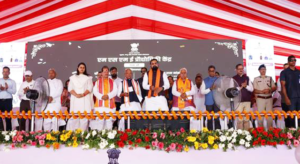
Last month, Prime Minister Shri Narendra Modi laid the foundation stone of the PM MITRA Park at Amaravati in Maharashtra. This is one of the 7 Parks sanctioned across the country under the flagship PM MITRA Park scheme. With world class infrastructure including plug and play facilities, PM MITRA Parks shall be a major step in realizing the vision of making India a global hub for textile manufacturing investment and exports. Each PM MITRA Park when complete is expected to attract an investment of Rs 10,000 crores and generate nearly 1 lakh direct employment & 2 lakh indirect employment.
PLI Scheme, with a total projected investment of over Rs. 28,000 crore, projected turnover of over Rs. 2,00,000 crore and proposed employment generation of nearly 2.5 lakhs is intended to promote production of MMF Apparel & Fabrics and Technical Textiles products in the country to enable textile industry to achieve size and scale.
The National Technical Textiles Mission is specialized mission with a focus on developing usage of technical textiles in various flagship missions and programmes of the country including strategic sectors. The Mission promotes startups and research projects covering specialty fibres and composites, geotextiles, agro textiles, protective textiles, medical textiles, defence textiles, sports textiles, and environment friendly textiles.
The supportive policy framework at the central level is supplemented by the policy initiatives of a number of states with a high growth potential in textiles.


