









The importance of textiles in shaping thermal comfort during sport has come into sharper focus with new scientific findings, positioning wool as a clear outperformer when it comes to regulating body temperature and moisture. Among fibres tested, Merino wool consistently delivered the strongest results, offering a moisture buffering capability superior to all major fibre types and an impressive 96% advantage over polyester. This highlights Merino’s remarkable ability to stabilise the delicate microclimate between skin and fabric, keeping athletes in their comfort zone even as conditions change.
Backed by breakthrough science, these findings show that Merino wool helps regulate body temperature far more effectively than traditional performance fibres. A four-year research program, spearheaded by North Carolina State University, tested Merino wool base-layer garments across dynamic stop-go sports such as cycling, rock climbing, hiking, and golf. The study demonstrated that 100% Merino base layers deliver superior thermal comfort and performance benefits thanks to what researchers call dynamic breathability—a fibre’s ability to respond in real time to varying physical demands. This means Merino manages heat and moisture efficiently during intense exertion while preserving warmth when activity slows, unlike many synthetic fabrics that fail to adapt once the body stops working.
For athletes, this adaptability reduces the risk of after-chill, a sudden cooling effect commonly experienced when sweat evaporates during rest periods in outdoor sports. By maintaining thermal equilibrium, Merino helps conserve energy and sustain comfort, ensuring the body expends less effort trying to regulate its core temperature. With the human body striving to maintain around 35°C at the skin’s surface during activity, wool’s ability to assist in this process becomes an invaluable performance tool.
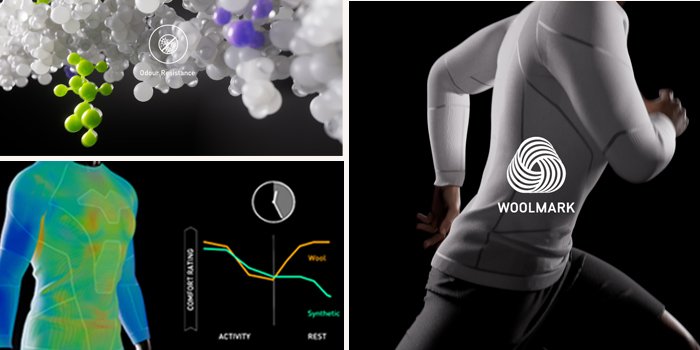
This research is about understanding the ongoing transition between activity and recovery, explains Woolmark Managing Director John Roberts. “Merino wool’s natural structure is designed to support performance, responding instantly to changing physiological needs. It automatically keeps athletes near their comfort zone, allowing them to focus fully on the challenge ahead—whether it’s climbing a rock face or pushing through a cycling sprint.
Key Findings from the Study:
Superior Regulation in Real-World Conditions: In climate-controlled human trials, all fibres performed similarly during the activity phase. However, only Merino maintained comfort consistently across both exertion and rest.
Moisture Management Excellence: Merino’s dual-layer structure—hydrophobic on the outside and hydrophilic inside—absorbs up to a third of its weight in vapour without feeling wet, enabling better moisture transport and microclimate stability.
Thermal Stability Advantage: Merino wool garments sustained a steadier next-to-skin environment across repeated bursts of activity and recovery, reducing the body’s workload to remain comfortable.
The research also underlined that traditional steady-state testing overlooked the hygroscopic nature of natural fibres —their ability to absorb environmental moisture and regulate temperature as a result. This study corrects that gap, proving scientifically what athletes have long experienced: Merino wool breathes, buffers, and adapts better than synthetics in diverse conditions.
The findings have already attracted attention from major sportswear brands eager to incorporate Merino wool into advanced apparel designs. Compared to other fibres, wool recorded 96% better moisture buffering than polyester, 45% better than cotton, and 26% better than viscose. Test participants consistently reported greater comfort and reduced after-chill when wearing Merino garments.
For product designers and innovators, this represents a turning point. The demand is shifting from garments that are merely lightweight or quick-drying to those offering sustained performance in real-world conditions. Merino wool, with its natural dynamic breathability, gives designers an opportunity to elevate apparel functionality without reliance on synthetic blends. It proves that the future of high-performance sportswear lies in fibres that work with the body, not against it—and Merino wool is leading the way.
Subscribe our WhatsApp Channel FREE to get regular updates – Click here
Enlist your name FREE in Apparel Manufacturers Directory – Click here