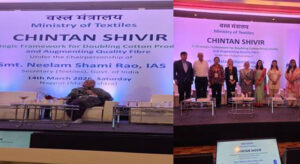





The Ministry of Textiles today unveiled the District-Led Textiles Transformation (DLTT) initiative at the National Textile Ministers’ Conference in Guwahati, marking a significant step towards accelerating inclusive, sustainable and export-led growth across India’s textile sector.
The DLTT initiative adopts a sector-specific, district-level approach aimed at transforming 100 high-potential districts into Global Export Champions while uplifting 100 Aspirational Districts into self-reliant textile hubs. By decentralising policy execution and aligning it with local strengths, the Ministry seeks to build globally competitive textile ecosystems rooted in regional capabilities.
As part of the initiative, the Ministry undertook a comprehensive, data-driven assessment of districts across the country. Districts were evaluated using a scoring methodology based on three key parameters — export performance, MSME ecosystem strength and workforce presence. Based on this analysis, districts have been categorised into two groups: Champion Districts and Aspirational Districts, each supported through a differentiated implementation strategy.
Champion Districts, identified for their scale and sophistication, will focus on addressing advanced growth constraints. Planned interventions include upgrading existing Common Facility Centres into Mega CFCs, adoption of Industry 4.0 technologies, and facilitating direct export market linkages to enhance global competitiveness.
Aspirational Districts, which require foundational ecosystem development, will concentrate on formalisation and capacity building. Key measures include basic skill development and certification, creation of Raw Material Banks, and promotion of micro-enterprises through Self-Help Groups (SHGs) and cooperatives, with the objective of strengthening grassroots participation and employment.
The initiative places special emphasis on Purvodaya convergence, prioritising the eastern and northeastern regions of the country. These zones will receive focused support for tribal belt development, improved connectivity and Geographical Indication (GI) tagging, enabling region-specific textiles and handicrafts to access premium global markets while preserving cultural heritage.
Through strategic convergence of central and state government resources, along with active collaboration with industry and academic institutions, the DLTT programme aims to strengthen textile clusters and systematically scale successful district models nationwide. The Ministry believes the initiative will play a pivotal role in enhancing exports, generating employment and positioning India as a globally competitive and resilient textile manufacturing powerhouse.
Source: PIB
(Rewritten & adapted by Indian-Apparel.com News Desk)
Subscribe our WhatsApp Channel FREE to get regular updates – Click here
Enlist your name FREE in Apparel Manufacturers Directory – Click here