






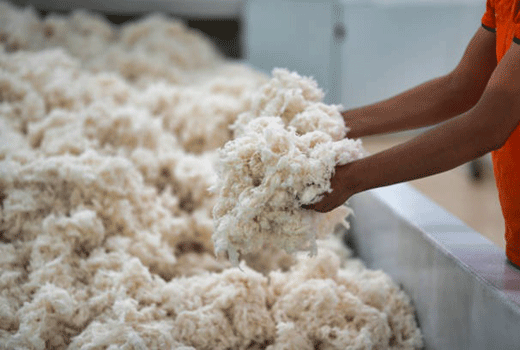
India’s textile industry, which plays a vital role in the country’s economic framework and stands as the second-largest employment generator after agriculture, has received a timely policy boost. The Government of India has officially extended the import duty exemption on cotton until 31st December 2025, as announced through a notification by the Central Board of Indirect Taxes and Customs (CBIC). This extension is poised to significantly ease the cost burden for textile manufacturers across the value chain—from spinning and weaving units to garment exporters—while ensuring stability in cotton availability.
The decision addresses the ongoing mismatch between domestic cotton supply and industry demand. Volatile cotton production due to erratic weather patterns, pest infestations, and changing cropping patterns has disrupted supply consistency. At the same time, the growing demand from textile manufacturers has kept pressure on prices. The exemption is thus a strategic move to guarantee access to high-quality, reasonably priced cotton, a critical raw material for the textile sector, while maintaining global cost competitiveness.
India is one of the world’s largest cotton producing nations, and the textile sector consumes the vast majority—around 95%—of the cotton produced domestically. Despite this, certain specialized varieties needed for specific applications, export requirements, or quality standards are not readily available in the local market. These imports, primarily used during off-peak domestic seasons, help meet production targets without directly competing with Indian-grown cotton.
The import duty exemption is expected to have a cascading positive effect across the textile value chain. It will help lower the cost of yarn, fabric, and final garments, encouraging more competitive pricing in international markets. This is crucial, especially for small and medium enterprises (SMEs) and export-oriented units (EOUs), many of which have struggled due to rising cotton input costs and stiff competition from other textile-exporting nations.
During April–October of FY 2024–25, cotton textiles accounted for nearly 33% of India’s total textile and apparel exports, generating USD 7.08 billion in revenue. This policy move will further boost these numbers, driving growth in high-value product segments and encouraging greater integration into global supply chains. It also supports broader national goals like ‘Make in India’ and Aatmanirbhar Bharat, by fostering self-reliance through enhanced cotton value addition and capacity expansion.
While the import of cotton offers benefits to manufacturers, the government has also ensured that the interests of cotton farmers are not compromised. The Cotton Corporation of India Ltd. (CCI) continues to implement the Minimum Support Price (MSP) policy, ensuring that farmers receive a minimum price that is 50% above their cost of production. This mechanism provides a financial safety net and protects cotton farmers from market volatility.
Additionally, since most cotton imports occur during lean supply periods or cater to specific technical needs, they do not pose a direct threat to domestic cotton sales. The government maintains close oversight of market dynamics and retains the authority to impose corrective measures—including reinstating import duties—if domestic cotton prices are negatively impacted.
The textile industry has welcomed the government’s decision with enthusiasm. Leading industry bodies and associations have expressed appreciation to Prime Minister Narendra Modi and Union Minister Giriraj Singh for extending the duty exemption, which has been a long-standing demand of the cotton sector. Industry stakeholders view this policy as a proactive step that will ensure greater stability, encourage investment, and safeguard millions of jobs in the cotton industry.
The extension of the cotton import duty exemption till December 2025 reflects the government’s commitment to supporting India’s textile sector through balanced and inclusive policymaking. By ensuring affordable, high-quality cotton supply, the measure not only strengthens the backbone of the textile economy but also promotes employment, export competitiveness, and rural prosperity. This strategic intervention is expected to play a key role in advancing India’s position as a global cotton manufacturing hub in the years ahead.
Subscribe our WhatsApp Channel FREE to get regular updates – Click here
Enlist your name FREE in Apparel Manufacturers Directory – Click here