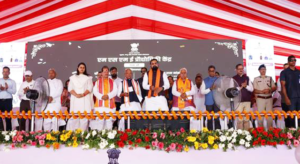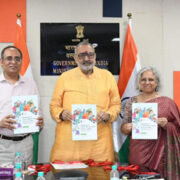



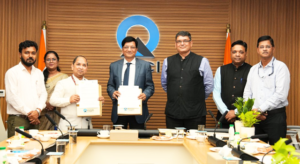
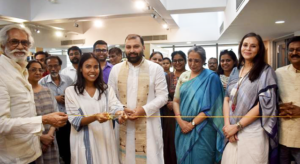





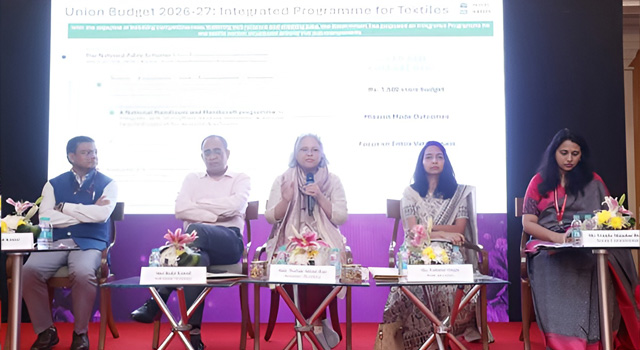
Union Budget 2026-27 Textile Initiatives were the focus of a Western Zone States’ consultation meeting held today in Mumbai under the chairpersonship of Neelam Shami Rao, Secretary, Ministry of Textiles, Government of India. Senior officers from the Ministry of Textiles, including Rohit Kansal, Additional Secretary; Padmini Singla, Joint Secretary (Fibre); Vrunda Manohar Desai, Textile Commissioner, Mumbai; and Akhilesh Kumar, Deputy Director General, also participated in the meeting.
The consultation brought together representatives from State Governments, industry associations, and key stakeholders from the textile value chain to deliberate on the effective implementation and strengthening of the newly announced textile sector schemes in the Union Budget 2026-27.
During the meeting, discussions focused on the major initiatives proposed in the Union Budget 2026–27 aimed at strengthening India’s textile ecosystem across the entire value chain. These include programmes on skilling and capacity building, fibre development, sustainability, cluster expansion, infrastructure development, and strengthening of traditional sectors such as handloom and handicrafts.
Among the key initiatives discussed were:
- Samarth 2.0 for large-scale skilling, reskilling and upskilling across the textile value chain. The scheme aims to skill 15 lakh individuals over five years to create a future-ready workforce aligned with technological and industry requirements.
Samarth 2.0 represents a transformative, demand driven intervention that holistically addresses the skilling and capacity-building needs of one of India’s most vital industrial sectors.
- National Fibre Scheme (2026–2031) aimed at strengthening India’s raw material base across natural fibres, man-made fibres and new-age fibres, while boosting domestic production and reducing import dependence. By addressing systemic bottlenecks, modernising infrastructure, upskilling the workforce, and aggressively developing markets, the Scheme can establish India as a leading exporter of premium, sustainable fibres by 2030-31.
- Tex Eco Initiative – Mission for Sustainable Textiles, which seeks to promote circularity, cleaner production and sustainability across the textile value chain while supporting MSMEs in meeting global environmental standards.
- Textile Expansion and Employment (TEEM) Scheme, designed to modernise textile clusters, improve productivity and generate large-scale employment across weaving, processing and garmenting segments. The TEEM scheme is expected to drive large-scale investment, employment generation and productivity enhancement across the textile value chain, while strengthening India’s global competitiveness through cluster-led modernisation and technology upgradation.
- Expansion of Mega Textile Parks in Challenge Mode, aimed at creating world-class integrated textile manufacturing ecosystems to strengthen India’s global competitiveness.
- National Handloom and Handicraft Programme (NHHP) and the Mahatma Gandhi Gram Swaraj Initiative, focusing on strengthening traditional sectors, improving market access, enhancing skills and promoting branding of handmade products. The National Handloom & Handicraft Programme (NHHP) aims to transform India’s handloom and handicraft sectors into a globally competitive, inclusive, and innovation-driven creative economy aligned with national priorities.
Addressing the participants, the Secretary (Textiles) emphasised the importance of cooperative federalism and stakeholder engagement in shaping effective schemes that respond to the needs of states and industry. She highlighted that these initiatives aim to enhance competitiveness, promote sustainable growth, generate employment and position India as a leading global textile hub.
Rohit Kansal, Additional Secretary briefed about the Union Budget 2026-27 highlights with regard to Integrated programme for textiles including The National Fibre Scheme, Textile Expansion and Employment Scheme etc while emphasizing the role of State government and Industry Stakeholders for successful implementation. A brief notice for the upcoming Bharat Tex Initiative (to be held in the period of 14th to 17th July 2026 at Delhi) was also shared by the Additional Secretary thereby requesting States and Industry Stakeholders to participate.
Participants from Western Zone states and industry representatives shared valuable suggestions and insights on strengthening the schemes and ensuring their effective implementation at the ground level.
The consultation forms part of a series of regional engagements being undertaken by the Ministry of Textiles to gather feedback from States and stakeholders before finalising the framework for implementation of the textile sector initiatives announced in the Union Budget 2026–27.
Subscribe our WhatsApp Channel FREE to get regular updates – Click here
Enlist your name FREE in Apparel Manufacturers Directory – Click here