








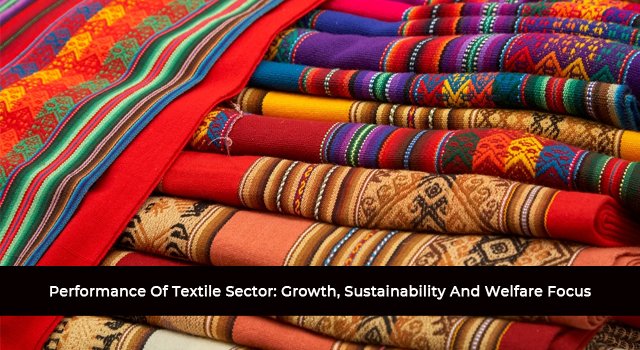
Performance of the Textile Sector is reflected in India’s global exports of textiles and apparel, including handicrafts, over the last three years, as detailed below:
| India’s Global Textile & Apparel including Handicrafts Exports (Values in USD Million) | ||||
| Sl No. | Commodity | FY 2022-2023 | FY 2023-2024 | FY 2024-2025 |
| 1 | Readymade Garment | 16,190.96 | 14,532.19 | 15,989.34 |
| 2 | Cotton Textiles | 11,084.81 | 12,258.13 | 12,298.90 |
| 3 | Man-made textiles | 5,411.98 | 5,080.64 | 5,294.60 |
| 4 | Wool & Woolen textiles | 204.75 | 192.40 | 160.26 |
| 5 | Silk Products | 94.56 | 119.25 | 162.09 |
| 6 | Handloom Products | 182.52 | 140.40 | 141.96 |
| 7 | Carpets | 1,366.11 | 1,395.15 | 1,541.11 |
| 8 | Jute Products | 461.71 | 353.50 | 399.89 |
| Total Textile & Apparel exports | 34,997.40 | 34,071.65 | 35,988.16 | |
| 9 | Handicrafts | 1,688.58 | 1,802.29 | 1,766.83 |
| Total T&A including Handicrafts exports | 36,685.98 | 35,873.94 | 37,754.99 | |
Source: DGCI&S
The exports of the Apparel & Textile sector, including handicrafts, increased from USD 36.65 billion in 2022–23 to USD 37.75 billion in 2024–25, registering a compound annual growth rate (CAGR) of about 1.49 per cent, reflecting the relative resilience of the sector despite global economic headwinds.
The Government is closely monitoring the emerging international regulatory frameworks, including carbon-border measures and labour-compliance standards, and their potential implications for India’s textile and apparel exports. As textile products are presently not covered under the EU’s Carbon Border Adjustment Mechanism (CBAM), no direct impact on the sector has been observed. Nevertheless, the Ministry, in consultation with the Department of Commerce and other concerned Ministries, continues to assess possible indirect effects and future developments. Labour-related compliance requirements introduced by major trading partners are also being examined in consultation with industry stakeholders. The Government remains committed to supporting exporters through capacity-building initiatives and sustained policy engagement to mitigate any potential adverse impact.
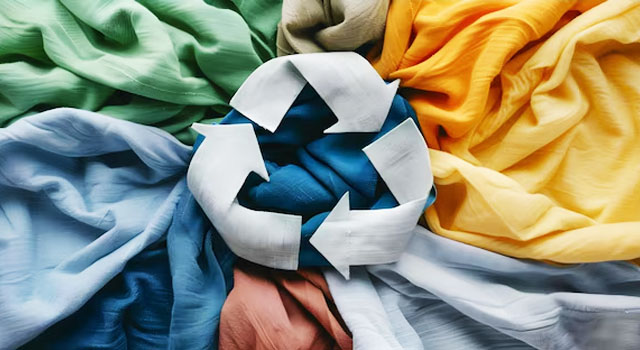
The Ministry of Textiles is taking various initiatives to promote sustainability and circularity in the textile sector:
- For promotion of upcycling, a tripartite MoU was signed between Textiles Committee, GeM and Standing Conference of Public Enterprises (SCOPE) to promote and mainstream the public procurement of upcycled products.
- For promotion of sustainability in textile sector, various steps such as Circle Back campaign aimed at raising awareness among students about textile recycling, organization of exhibitions such as Vastra Katha at Bharat Tex 2024 & 2025 have been taken.
Workers, including women, who draw wages not exceeding the wage ceiling for ESI coverage working in garment factories and handloom units employing 10 or more employees are already eligible for ESI coverage.
The Code on Social Security 2020 which has come into force on 21.11.2025 also has provisions for voluntary coverage of establishment and also to unorganized workers as per the Scheme framed by the Central Govt.
Ministry of Textiles, Government of India is implementing following schemes for welfare of handloom weavers/workers under National Handloom Development Programme across the country:
- Financial support of Rs.8,000/- per month to Awardee handloom weavers/workers above 60 years of age, in indigent circumstances having annual income below Rs.1.00 lakh and Scholarship upto Rs.2.00 lakh per annum to handloom weavers/workers’ child (upto 2 children) for study in Diploma/Under Graduate/Post Graduate courses of Central/State Govt. recognized/funded Textiles Institutions.
- Universal and affordable social security in case of natural/accidental death and total/partial disability through insurance schemes i.e. Pradhan Mantri Jeevan Jyoti Bima Yojana (PMJJBY) and Pradhan Mantri Suraksha Bima Yojana (PMSBY).
The Ministry of Textiles has constituted an Environmental, Social and Governance (ESG) Taskforce as a multi-stakeholder platform including but not limited to industry, labour, and environmental representatives. The objective of the Taskforce is to identify key hotspots in the textile value chain and to support the transition of the textile and apparel industry towards a sustainable and resource-efficient production system. No proposal to establish a separate “National Textile Sustainability Council” has been received.
This information was provided by THE MINISTER OF STATE FOR TEXTILES PABITRA MARGHERITA in a written reply to a question in Lok Sabha.
Subscribe our WhatsApp Channel FREE to get regular updates – Click here
Enlist your name FREE in Apparel Manufacturers Directory – Click here