





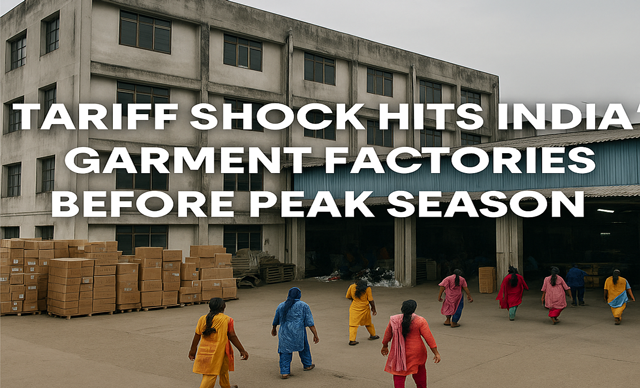
This has turned into a precarious moment for the Indian garment industry as the implications of the US tariff regime stretch far beyond spreadsheets. The measures have disrupted trade flows and unsettled the lives of millions who depend on the sector for survival. More than just an economic hurdle, the tariff highlights the vulnerability of export-led industries and the deep influence of global trade decisions on local livelihoods.
As exporters gear up for what is typically their busiest production season, a cloud of doubt hangs over India’s garment hubs. The imposition of a steep 50% US tariff on apparel imports has left buyers hesitant, cutting into margins and leaving many units underutilized. This period, which usually brings fresh orders and peak activity, has instead been marked by shrinking demand and slowing production.
The frantic rush to ship goods before the tariff deadline gave way to a slump once the duties came into effect. Small and mid-sized factories, most dependent on the US market, are feeling the harshest pinch. Forced to scale back operations, many have cut shifts, leaving low-wage workers most affected. According to Times of India journalist Ashni Dhaor, the weight of the tariff is being borne disproportionately by those at the bottom of the workforce.
For unskilled workers, the tariff shock has turned a normally busy season into a year of uncertainty. “I had to get a construction job,” said Bharat Prajapati, a former garment worker who lost shifts after exports slowed. His story mirrors that of thousands of daily-wage earners who rely on seasonal employment in garment units but have now been displaced by the ripple effects of the tariff.
The period between May and September usually provides stable opportunities for casual labour, yet this year the tariff has shut those doors. Instead of steady factory work, many labourers are left scrambling for alternatives. The disruption illustrates how a policy decision taken abroad can devastate workers’ prospects half a world away.
Inside the factories, the change in mood is evident. While machinery still operates for non-US buyers, the urgency has faded. Workers know the tariff is slowing production. Stitcher Poonam Yadav described how managers are stretching schedules and reducing targets to as few as five pieces a day—concrete proof that the tariff has drained the industry’s momentum.
The confusion surrounding the tariff has deepened frustration on the shop floor. Only weeks ago, workers pushed overtime to dispatch goods ahead of the duty hike, expecting a temporary surge. Instead, the tariff has ushered in a slowdown, leaving many uncertain about both their present and their future.
In cafeteria conversations, the tariff dominates every discussion. Rumours of layoffs spread quickly, with workers like Gyanesh Kumar fearing that management is tracking low-output performers for cuts. The tariff has not only reduced orders but also shaken confidence, eroding morale across units.
Labour contractors warn that the freeze in hiring is directly tied to the tariff. Normally, factories expand their workforce at this time, but new recruitment has stopped and renewals are in doubt. Families where both spouses work in the industry face double the financial strain as the tariff continues to squeeze incomes.
Managers admit that business decisions are now dictated by the tariff. Tikaram, who oversees an export unit in Sector 59, said companies typically hire 30 to 40 skilled workers during peak months. This year, however, the tariff has forced them to cancel those plans. The fear is that prolonged uncertainty could drive skilled labour away from the garment trade altogether.
HR managers have been tasked with easing tensions, telling workers that government talks with Washington are ongoing. Yet for many employees, these assurances mean little while the tariff remains in place and overtime shifts disappear.
As weeks drag on without a solution, confidence continues to weaken. The tariff has not only slowed production but has also exposed the fragility of export-dependent industries. Until clarity emerges, every garment stitched in India’s factories will carry the weight of tariff-driven uncertainty, a reminder of how global policies can unravel local lives in an instant.
Subscribe our WhatsApp Channel FREE to get regular updates – Click here
Enlist your name FREE in Apparel Manufacturers Directory – Click here